
All explainers · Reading a transit network
Bus bunching: why buses arrive in pairs
Animation paused (reduced motion). Press play to watch.
In one sentence
A late bus collects more passengers and gets later; the bus behind gets emptier and faster — until they run together.
Why it matters
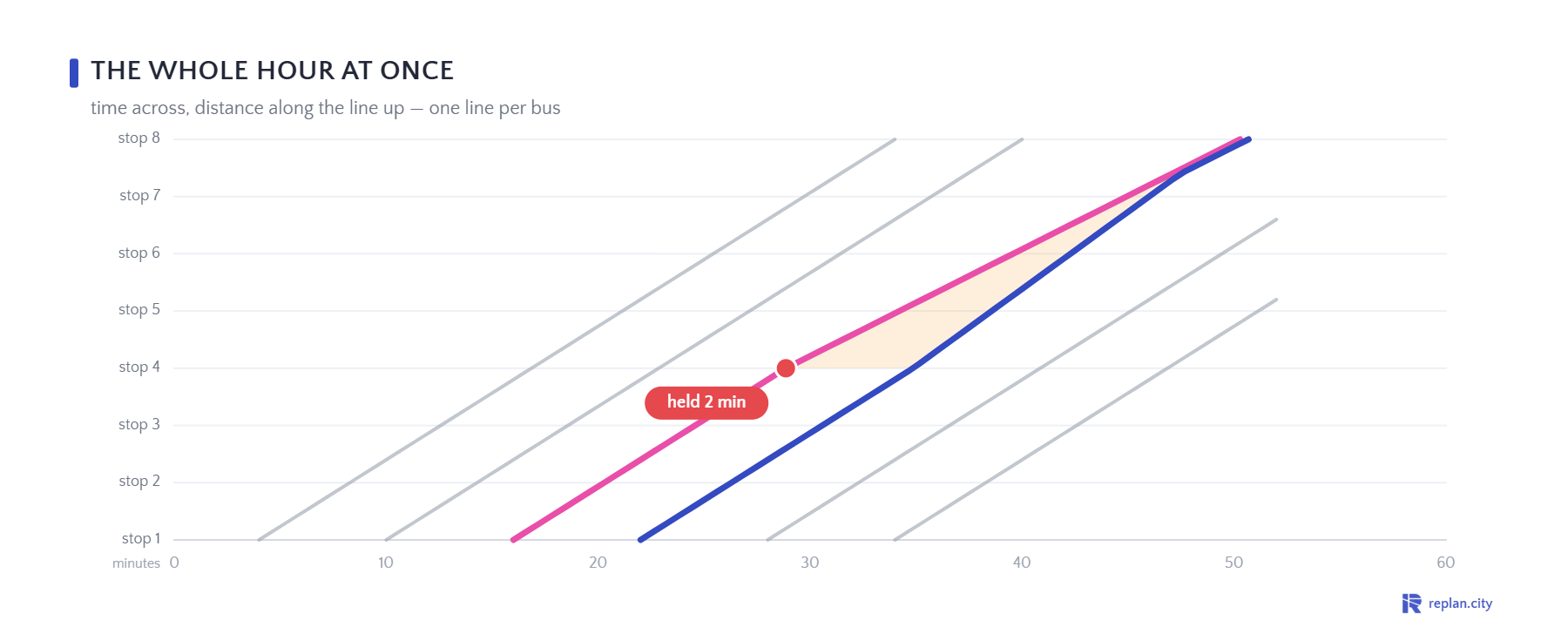
On a frequent route, headways are unstable by nature. One delay — a signal, a boarding surge — leaves a larger gap in front of the late bus, so more passengers are waiting at the next stop, dwell time grows and the bus falls further behind. The bus behind it meets the opposite: fewer passengers, shorter dwells, and it catches up. Newell and Potts described this instability in 1964; it is why buses on a 6-minute service arrive in pairs followed by a 12-minute gap.
The consequence for planning: average speed and timetable adherence do not describe what passengers experience — headway regularity does. Holding buses at control points until the bus ahead is a full headway away (headway-based control, Daganzo 2009) keeps the service even; simply adding running-time buffer to the timetable does not.
Sources
- Newell, G. F. & Potts, R. B. (1964). Maintaining a bus schedule. Proceedings of the 2nd Australian Road Research Board Conference, 2(1), 388–393.
- Daganzo, C. F. (2009). A headway-based approach to eliminate bus bunching. Transportation Research Part B, 43(10), 913–921.
- Bartholdi, J. J. & Eisenstein, D. D. (2012). A self-coördinating bus route to resist bus bunching. Transportation Research Part B, 46(4), 481–491.
- Schematic illustration; headways, speeds and holding times are illustrative.
In Replan
The Stringline view of the Scheduling Editor shows vehicle trajectories on exactly this time–distance diagram, so converging lines are visible while the timetable is being built. Replan SIM reports headway reliability per stop and per period from the simulated day, before the service runs.
What you see
- 00.0Even headways
- 10.0One bus is held
- 20.0The feedback loop
- 32.0The whole hour at once
- 46.0Headway control
- 54.0In Replan
Use this explainer
Poster (PNG) · MP4 / GIF: rendered on request
Embed: <iframe src="https://www.replan.city/explains/embed/bus-bunching.html?lang=en" width="900" height="360" style="border:0;max-width:100%;aspect-ratio:5/2" loading="lazy" title="Bus bunching: why buses arrive in pairs"></iframe>
Paste into any page; the explainer plays as live SVG (no video file).
Licence: CC BY 4.0 — reuse freely with the line “Replan GmbH · replan.city/explains”. The Replan mark in the corner stays.
See it on your own network
Book a demoRelated explainers
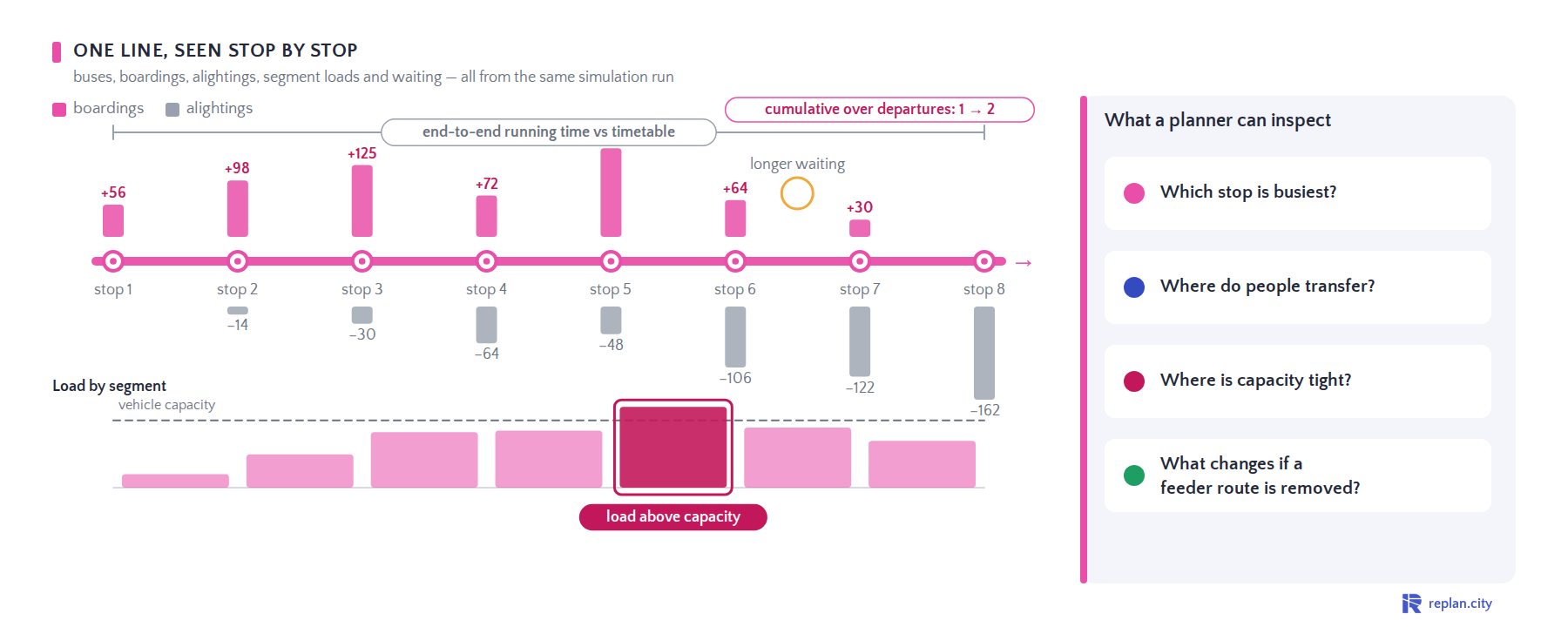
Looking inside the line, not only at total demand
Buses, boardings, alightings, segment loads and waiting — all from the same simulation run.
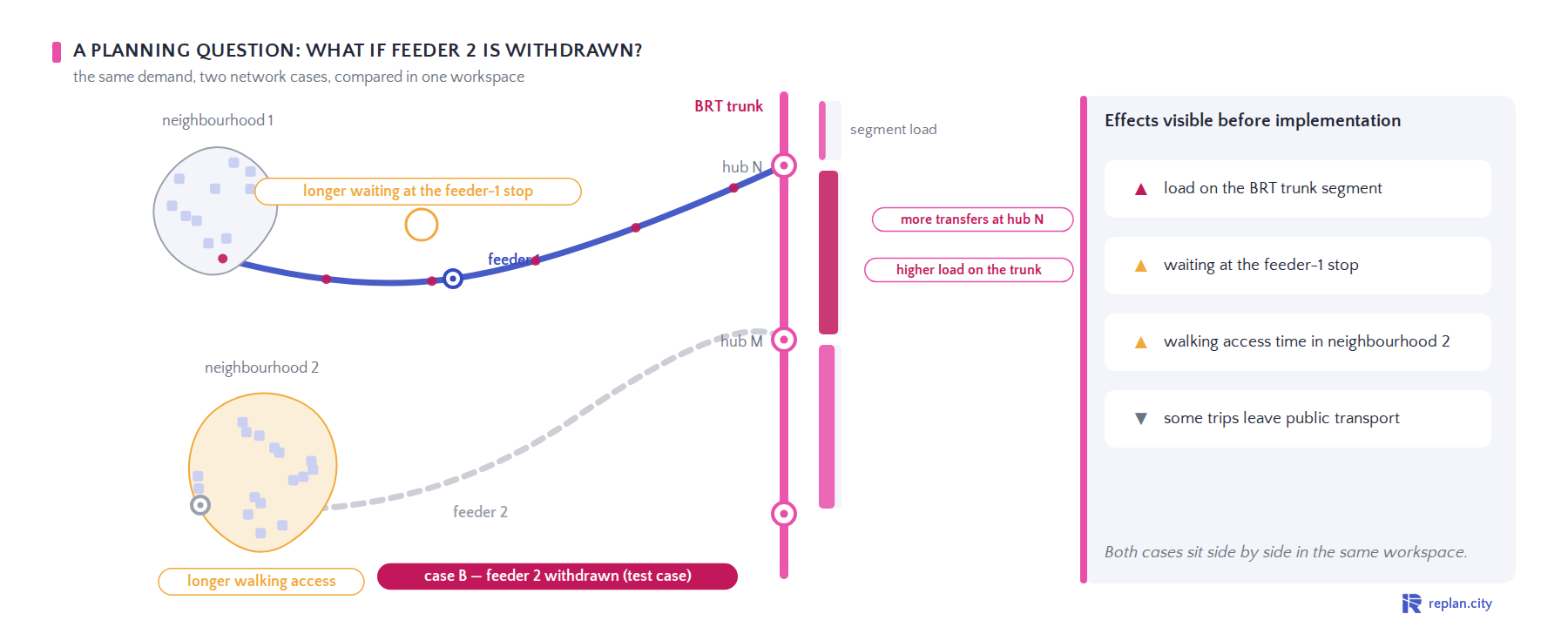
Testing a feeder change before implementation
Both cases sit side by side in the same workspace.
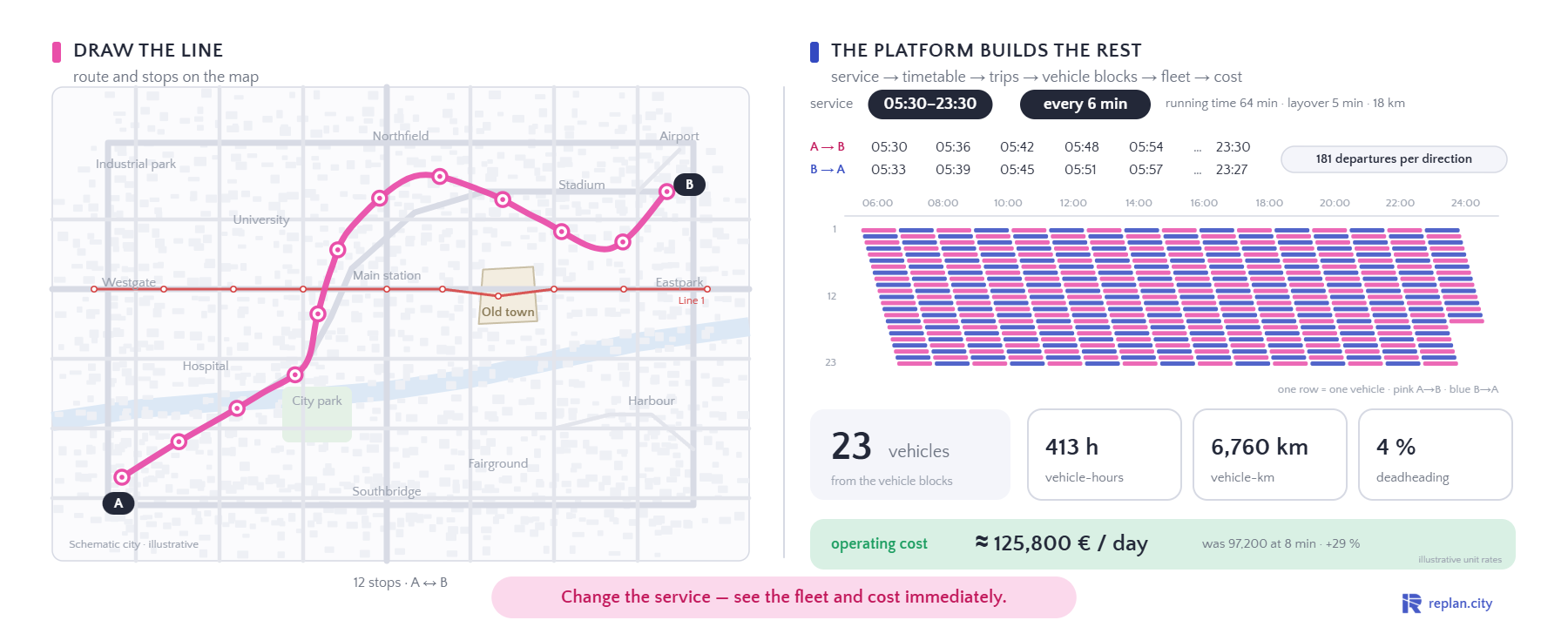
From a line sketch to buses and cost
Change the service — see the fleet and cost immediately.